There are two honest ways to describe the same morning. The first is reassuring: the price of overnight secured cash is 2.8 basis points below the Federal Reserve’s interest rate on reserve balances, Standing Repo Facility use is only $0.10 billion, and Seiche’s market-stress basket sits at the 30th percentile of its own history. Nothing in those prints resembles a scramble for cash.
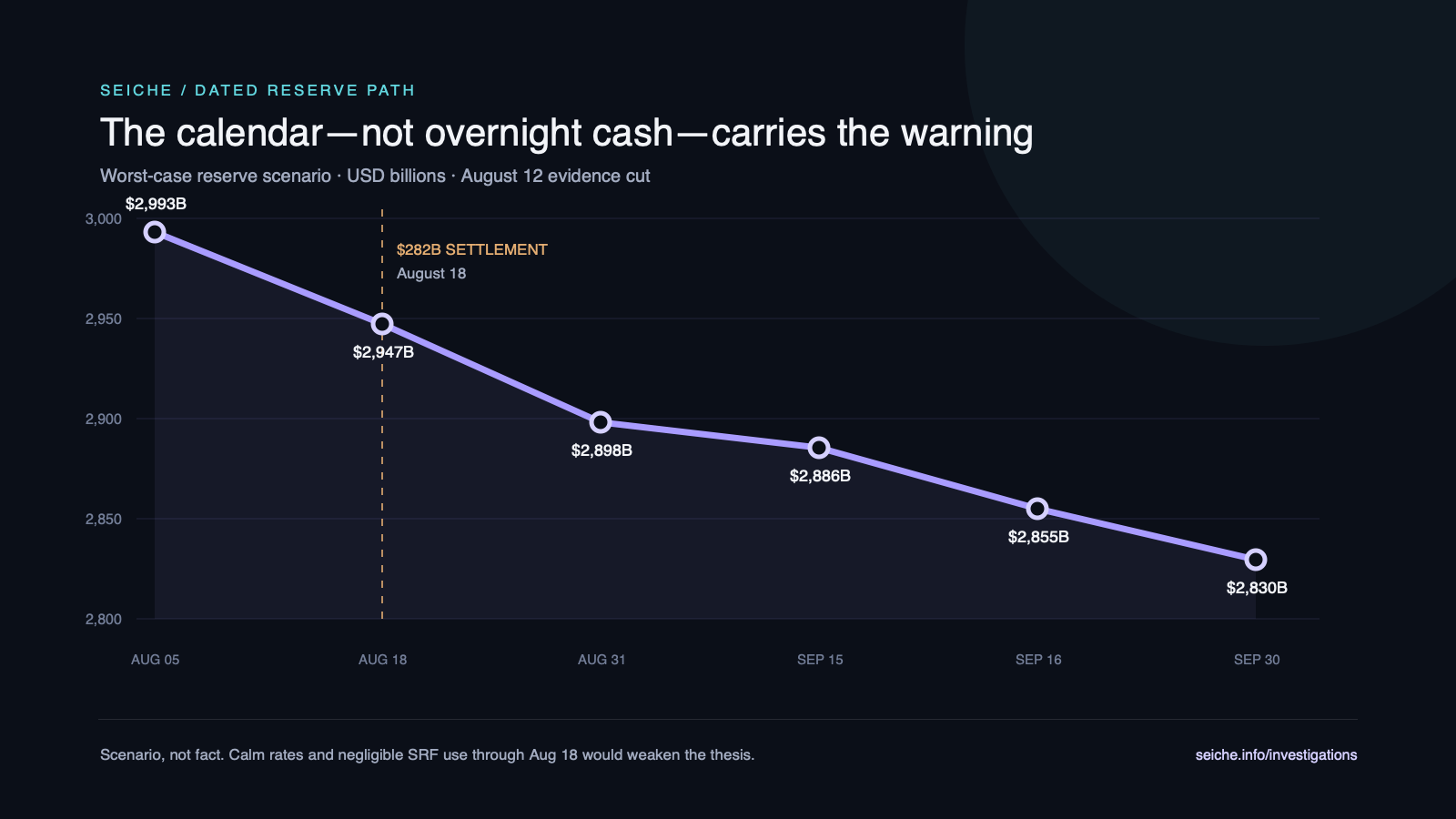
The second is less comfortable. Reserve balances were $2.993 trillion on the latest H.4.1 observation, about $710 billion below Seiche’s fitted reserve-demand kink. On August 18, $282 billion of auction settlement is scheduled to pass through that already thinner buffer. Under Seiche’s published worst-case assumptions, reserves reach $2.947 trillion that day.
A calm overnight rate tells us cash is available now. It does not tell us how the system absorbs a dated balance-sheet demand next Tuesday.
The warning lives in the disagreement
Seiche calls the funding regime EROSION, not crisis. Its composite reads 45 out of 100. The “Tell”—the gap between plumbing indicators and market-price indicators—is +31 percentile points. Plumbing is tighter relative to its own history than the screens traders normally watch.
That gap matters because the components answer different questions. SOFR measures the cost of overnight Treasury financing in completed transactions. The reserve path is a balance-sheet identity pushed forward through known calendar dates. One is a market clearing price; the other is a capacity test. Treating either as the whole system would erase the useful disagreement.
Why August 18 earned a red circle
The date is not selected because it looks dramatic on a calendar. Seiche joins the Treasury auction schedule to the Fed balance sheet and asks what happens when settlements, Treasury cash movements and a conservative residual shock arrive together. The published base path puts reserves at $3.008 trillion. The published worst-case path puts them at $2.947 trillion.
Those values are model outputs, not promises. Their use is narrower: they identify a day on which current abundance can be tested in public. If secured rates remain well behaved, backstop use stays negligible and the realised balance sheet absorbs the settlement, the structural warning loses force.
THE STRONGEST COUNTER-CASE
The system is already demonstrating that reserves are ample enough. SOFR below IORB is a direct abundance signal; a $0.10 billion SRF print is operationally trivial; and market stress at the 30th percentile says investors are not paying for a funding accident. A fitted kink can be stale or miss behavioural adaptation. The calendar may pass without incident.
What would turn a test into evidence
Watch the spread of SOFR to IORB, the tails of the repo-rate distribution, Standing Repo Facility take-up and the realised H.4.1 reserve change. A broad move across those independent surfaces would be confirmation. One noisy print would not.
The inverse is equally important. If settlement clears with SOFR still below IORB, thin tails, negligible SRF use and no unusual reserve loss, the correct headline is not “crisis averted.” It is “the buffer absorbed the test,” and the Seiche model should carry that miss or non-event into its public record.
WHAT CHANGES OUR MIND
Calm secured rates, immaterial SRF use and a realised reserve path materially above the published worst-case band through August 18 would weaken this thesis. The dated test is valuable precisely because it can fail.
Sources and method
- Seiche public point-in-time snapshot, generated August 12, 2026; composite, editorial evidence, counter-case and dated reserve path.
- Federal Reserve H.4.1; reserve balances and the factors affecting them.
- New York Fed SOFR; the transaction-based overnight secured funding rate.
- New York Fed repo operations; Standing Repo Facility results.
- Treasury Securities Auctions Data; announced securities and issue dates.
Limitations. The reserve-demand kink and forward path are Seiche derivations. Historical inputs use final/current-vintage data where publication vintages are unavailable, so the construction is not eligible to be called a validated backtest. This article is public-data research, not investment advice.